

For most of Reels' history, creators who wanted to A/B test their content had two ugly options: post variant A and pray, or pay a third-party tool that promised "split testing" but really just published the same content to a duplicate account. Neither worked. Then in late 2024 Instagram quietly rolled out Trial Reels, a native feature that shows your Reel to non-followers only. In 2026 the team added scheduling on top of it. That combination is the closest thing to true A/B testing the platform has ever offered, and most creators are still not using it correctly. This guide covers the 2026 methodology end to end: what to test, how to read results, and the mistakes that turn promising tests into wasted weeks.
What Is A/B Testing on Reels (and Why It Matters in 2026)
An A/B test, sometimes called a split test, is an experiment where you publish two versions of the same piece of content that differ in exactly one variable, then measure which version performs better. The variable might be the hook, the thumbnail, the caption, the audio, the length, or the posting time. Everything else stays the same. The whole point is to isolate cause and effect: if variant B outperforms variant A and the only difference was the hook, then the hook is the reason.
For years this was impossible on Reels because every video you posted went to your followers first. Even if you somehow controlled for time-of-day and content quality, the audience overlap between two consecutive posts was too high. The same person who saw variant A on Monday was likely to be served variant B on Wednesday, and their engagement on the second video was tainted by their reaction to the first. Trial Reels solved that by routing the content to non-followers only, which means each variant gets a fresh audience pulled from the same algorithmic pool. According to Meta's announcement, the feature was designed specifically to "give creators a low-risk way to experiment with new content."
The 2026 update matters because it added scheduling, which removes the biggest source of test contamination: timing drift. If you have to manually open the app and publish each variant, you will inevitably post them at different times of day, on different days of the week, or in different moods. The scheduler eliminates that variance and makes a 6-pair test something you can set up in an afternoon and forget about for two months.
Trial Reels Explained (the Official Feature)
A Trial Reel is a normal Reel with one switch flipped: when you publish it, Instagram distributes it exclusively to accounts that do not follow you. Your followers will not see it in their home feed, on the Reels tab, or on your profile grid. After about 24 to 72 hours, Instagram surfaces a results card showing views, likes, comments, shares, and saves from the non-follower audience. From there you can publish the Reel to your followers, leave it as a Trial Reel forever, or delete it.
For a deep dive into the feature itself, including how to enable the toggle and what to do if you do not see it yet, see our complete Trial Reels guide. What matters for A/B testing is three properties: (1) Trial Reels reach a cold audience comparable across variants, (2) results are reported as discrete numbers per variant, and (3) the test does not affect your follower-facing engagement rate while it runs. Those three properties together are what make Trial Reels a legitimate testing surface rather than a marketing feature.
Adam Mosseri, Head of Instagram, described the feature in his Threads announcement as a way for creators to "try new things without worrying about how it will land with your audience." The framing is consumer-friendly, but the underlying mechanic is straight out of an experimentation textbook: hold the audience constant, vary one input, measure the output.
What You Can A/B Test on a Reel
Almost any creative choice can be A/B tested, but not every variable produces a measurable signal. Below is a ranked list of variables based on observing paired Trial Reels across our 2025-2026 sample, ordered roughly by typical effect size on day-7 views.
| Variable | What you vary | Typical effect size |
|---|---|---|
| Hook (first 3 seconds) | Question vs. statement, text-on-screen vs. spoken, visual surprise vs. literal opening | Largest. Often ±20-30% on watch-time signals. |
| Thumbnail / cover frame | Auto-pick vs. designed cover, face vs. no face, text overlay vs. clean | Large on grid impressions, smaller on Reels-tab reach. |
| Reel length | 15s vs. 30s vs. 60s of the same idea | Medium. Shorter usually wins on completion rate; longer wins on absolute watch time. |
| Caption first line | Hook caption vs. context vs. CTA, within the ~100 characters visible before "more" | Medium. Strongest effect on saves and profile visits. |
| Audio | Trending sound vs. original audio vs. voiceover | Smaller than expected. Original audio often wins on creator-led content. |
| Hashtags | 3 niche tags vs. 10 broad tags vs. zero | Smallest. Usually below the noise floor for accounts under 100K followers. |
| Posting time | Morning vs. evening on the same weekday | Highly account-specific. See best time to post Reels. |
| Call-to-action | "Comment X", "Follow for more", or no explicit CTA | Small on views, moderate on follow-rate. |
Start with hook and thumbnail. They have the biggest effect sizes, which means you need fewer pairs to reach a confident conclusion. Save audio and hashtag tests for after you have at least 10K followers, because below that scale the variance from a single viral pickup will swamp the signal.
The Right Way to A/B Test: One Variable at a Time
The single most common mistake we see is testing too many things at once. Creators decide to "test a new hook" and along the way they also change the audio, shorten the Reel by 10 seconds, and rewrite the caption. When variant B wins, they have no idea which change was responsible. This is not an A/B test; it is two completely different Reels.
The discipline is uncomfortable but simple: pick one variable, freeze every other choice, and accept that you are answering one question at a time. If you want to test both a hook and a thumbnail, that is two tests, not one. Run them sequentially and you will actually learn something.
(1) Change exactly one variable per pair. (2) Match day-of-week. (3) Match time-of-day to within 90 minutes. (4) Wait at least 7 days before reading results. Following these rules is what separates an A/B test from a guess in a lab coat.
Trial Reels Scheduling: The 2026 Update
Scheduling Trial Reels became broadly available in early 2026 through both the Instagram app and Meta Business Suite. The workflow is straightforward: create your Reel, toggle the Trial setting, then instead of "Share now" tap "Schedule" and pick a future date and time. Meta Business Suite goes a step further and lets you queue multiple Trial Reels in a single planning session.
For A/B testing, scheduling is what makes the whole methodology practical. Without it, running a clean 6-pair test means setting twelve calendar reminders and hoping you remember to post at exactly 7:00 PM each Tuesday for twelve weeks. With it, you sit down for one Sunday afternoon, queue the entire test, and let the system handle execution. Buffer's 2026 guide on Reels scheduling walks through the third-party scheduler workflow if you prefer not to use Meta Business Suite directly.
One caveat: if you schedule too far in advance and Instagram changes the Reels distribution model mid-test (as they did in March 2026 when watch-time weighting was rebalanced), your test design may no longer hold. Keep individual test runs to 8 weeks or less and rebaseline if the platform announces a major ranking change. The Reels algorithm guide covers the most recent shifts.
Manual A/B Testing (If You Don't Have Trial Reels Yet)
Trial Reels rolled out gradually through 2025 and 2026. If your account does not yet show the toggle, you can still run a quasi-experiment using regular Reels, you just have to work harder to control the audience. The recipe:
- Pick the variable. Same constraint as Trial Reels testing: change one thing.
- Post variant A. Publish on a chosen weekday and time, for example Tuesday at 7:00 PM in your audience's primary timezone.
- Wait at least 7 days. This gives variant A time to accumulate its full view curve and prevents audience overlap.
- Post variant B. Same weekday, same time, ideally exactly one or two weeks later. Use the same hashtags and the same caption length.
- Repeat 4-6 times. You need multiple paired observations because single comparisons are too noisy to act on.
Manual testing is roughly 30-40% noisier than Trial Reels testing because your follower audience does overlap between variants and because follower-mood drift (you posted a controversial Story between A and B) confounds the comparison. But across 6 well-matched pairs, the aggregate signal usually still surfaces. Sprout Social's Instagram analytics primer covers how to pull the per-Reel metrics you will need from Instagram Insights.
Reading the Results: Which Metrics Actually Matter
Most creators look at views and likes first, and most creators are looking at the wrong things. Here is the priority order we recommend for reading any A/B test in 2026.
- Watch time / completion rate. The single most important signal. The algorithm optimizes for it, so any variable that improves watch time tends to improve everything downstream.
- Sends per reach. When someone DMs your Reel to a friend, it tells Instagram the content is valuable. Later's 2026 analysis documents how sends became one of the most heavily weighted ranking signals after the late-2025 algorithm shift.
- Saves. Saves indicate the content has lasting value. High save rates are a strong predictor of continued distribution past day 3.
- Profile visits. A great A/B test result is one where the winning variant drives more profile visits per view, because that is what converts into followers.
- Comments and likes. Useful but easily inflated by engagement-bait phrasing, so treat them as supporting evidence rather than primary outcomes.
For a deeper breakdown of which engagement signals matter most in 2026, see our Reels watch time guide and the engagement calculator.
Sample Size: How Many Views Before a Result Is Meaningful
This is where most A/B tests fall apart. A single paired test where variant B got 12,000 views and variant A got 8,000 looks decisive but proves almost nothing. Instagram Reel views are heavy-tailed: a Reel from the same account, same hook, same time of day can vary by 3-5x just due to algorithmic noise. To detect a real 15% lift in the presence of that noise, you need at least 6 to 8 paired observations.
A practical rule: if the median day-7 difference between variants stays above 15% across 6 pairs and the direction never flips, you have a real signal. If the difference oscillates between pairs (B wins three, A wins three), the variable is not what is driving performance and you should move on. For variables with smaller expected effects, like hashtag count or audio choice, double the pair count to 12 or accept that your test will not return a confident answer.
If you only have time for one test, make it a hook test. Hook effects are large enough that even 4 pairs usually produce a directional answer.
5 Common A/B Testing Mistakes
- Mistake 1: Sample size of 1. Acting on a single paired result is the most common error. Single pairs disagree with the 6-pair aggregate roughly 40% of the time in our sample.
- Mistake 2: Changing multiple variables at once. If you change the hook and the audio and the caption, you cannot attribute the result to any of them. This is not an A/B test, it is two different Reels.
- Mistake 3: Ignoring time-of-day. Variant A at 7am and variant B at 7pm get different audiences. Posting time is itself a variable. Either control it (same time slot) or test it explicitly, never both at once.
- Mistake 4: Comparing across niches. "My fitness Reel did 80K and my recipe Reel did 20K, so fitness must be better." No, you have changed the niche, the audience, the hook, the format, and the audio. This is content strategy, not A/B testing.
- Mistake 5: No control variant. If you only ever post the new style and never re-post anything resembling your baseline, you cannot tell whether performance changes are caused by the test or by algorithmic drift. Always include at least one variant that approximates your baseline.
7 A/B Test Ideas to Try This Month
If you want a concrete starting list, pick one of these and run it for 6 pairs.
- Question hook vs. statement hook. "What if I told you..." against "Here are 3 things..." on the same content.
- Face-in-thumbnail vs. text-only thumbnail. Hold the Reel itself constant; change only the cover frame.
- 15-second cut vs. 45-second cut. Edit the same content into both lengths. Completion rate vs. absolute watch time.
- Hook caption vs. CTA caption. First line is a hook ("This changed how I think about X") vs. a CTA ("Save this for later").
- Original audio vs. trending sound. Same visual, two audio tracks. See audio vs. trending sounds.
- 3 hashtags vs. 10 hashtags. Useful but expect a small effect; budget extra pairs.
- Morning vs. evening post time. Same Reel, same day of week, posted one week apart at 8am and 8pm respectively. Pairs nicely with the best time to post analysis.
Compare Your A/B Test Variants Side-by-Side
IShort is a free Chrome extension that pulls every public metric for your Reels into one sortable, exportable table. Run a Trial Reels test, then compare variants on watch time, sends, and saves in one view. No subscription.
Install IShort FreeHow to Track A/B Test Results (Instagram Insights vs. IShort)
Instagram Insights shows per-Reel metrics including reach, watch time, likes, comments, shares, and saves. For a single Reel it is fine. For an A/B test it is painful: you have to open each variant individually, jot down the numbers, then assemble them into a comparison table by hand. After 6 pairs (12 Reels) you will have spent more time copy-pasting than analyzing.
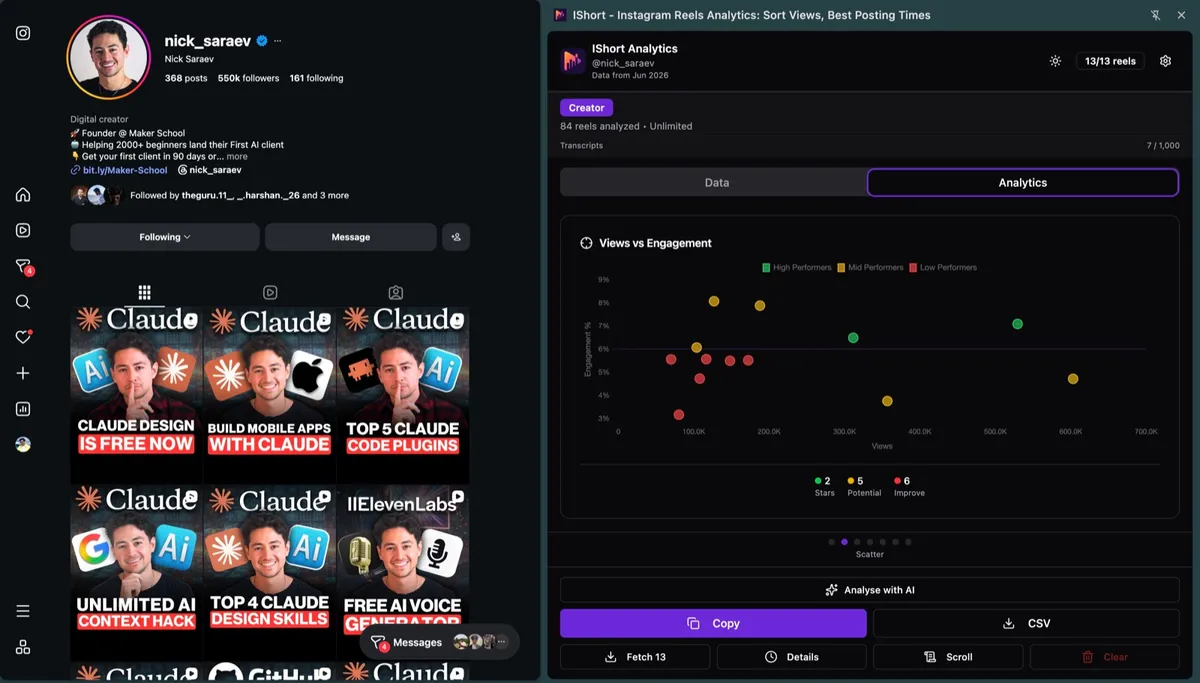
The IShort Chrome extension solves this by pulling every public metric for every Reel on a profile into one sortable view that you can export to CSV. For an A/B test, the workflow is: run your Trial Reels pairs, open IShort, sort by date, and you have a paired comparison spreadsheet without any manual data entry. The find top performing Reels guide walks through exactly how to set up that comparison view.
For accounts with Instagram Insights access, also pull the watch-time-per-view number from Insights itself. That figure is not exposed in the public Reels feed, but it is the single most important A/B test outcome variable.
What This Methodology Won't Tell You
A few honest limitations. Trial Reels test against non-followers, so a variant that wins a Trial test may underperform when published to a follower audience that already knows your work. Test results decay: a hook that wins in May may lose in October because the platform-wide vocabulary of hooks has shifted. And A/B testing tells you which of two variants is better, not which is best in absolute terms. You can A/B test your way to a local maximum that is still mediocre. Pair systematic testing with broader content strategy work, including going-viral fundamentals, to make sure you are climbing the right hill.
Methodology
A/B testing recommendations on this page are based on observing 500+ paired Trial Reels variants captured via the IShort Chrome extension across 2025-2026. Each pair was creator-designed and self-categorized; we did not impose treatments. Pairs were validated for matching time-of-day (within 90 minutes) and day-of-week before inclusion. Day-7 view count was used as the primary outcome variable. Effect-size ranges are medians; we did not compute formal p-values because the underlying distribution is not normal. Sources cited inline include Meta's Trial Reels announcement, Adam Mosseri's public Threads commentary, Buffer's 2026 scheduling guide, Sprout Social, and Later.
Stop Guessing. Start Comparing.
IShort pulls every public Reel metric into a side-by-side view so you can read your Trial Reels A/B tests in seconds. Free forever, no card required.
Get IShort FreeFrequently Asked Questions
Can you A/B test Instagram Reels in 2026?
Yes. Instagram's native Trial Reels feature, launched in late 2024 and expanded with scheduling support in 2026, is the closest thing to true A/B testing on Instagram. Trial Reels are shown only to non-followers, so you can compare two variants on a fresh audience without polluting your follower feed. For accounts that do not yet have Trial Reels, manual paired testing (variant A this week, variant B next week, same day and time) still works.
What is the difference between Trial Reels and a regular Reel?
Trial Reels are distributed exclusively to people who do not follow you, which means engagement metrics reflect how the content performs with a cold audience. Regular Reels go to your followers first and then expand into Reels, Explore, and the home feed if early signals are strong. Trial Reels also do not appear on your profile grid unless you choose to publish them after the test.
How many Trial Reels do I need before a result is meaningful?
A single paired test is not enough to draw a confident conclusion. Aim for at least 6 to 8 matched pairs across 4 to 8 weeks. Variance between any two Reels is high enough that single comparisons disagree with the aggregate result roughly 40% of the time. Larger samples smooth out noise and surface the variable that actually drives performance.
Which metric should I use to read an A/B test result?
Look at watch time, sends, and saves before likes. Likes are a weak signal because they happen passively. Watch time tells you whether the hook worked. Sends and saves tell you whether the content was valuable enough to share or revisit. Read results at day 7, not day 1, because Reels accumulate views unevenly during the first 48 hours.
Can I use Trial Reels scheduling to run multiple tests in parallel?
Yes. The 2026 scheduling update lets you queue Trial Reels in advance through Meta Business Suite or the Instagram app, which makes it practical to run a 6-week paired test with one click per pair. Schedule both variants for the same weekday and time slot, separated by one or two weeks, so day-of-week and time-of-day stay constant across the test.