

Quick Answer: Instagram Reels watch time is the strongest known ranking signal in 2026. Adam Mosseri publicly confirmed it across 2025 on @creators, and Meta's official ranking explainer still lists it first. The 3-second hook decides whether your Reel earns a view at all, and the November 2025 jump to 20-minute Reels did not change feed mechanics — sub-90s Reels still win discovery.
What Is Watch Time on Reels (and What It Is Not)
Watch time is the total number of seconds a Reel was watched, summed across every viewer and every replay. It is not the same as reach (how many unique accounts saw the Reel) and not the same as the public view count (which fires at the 3-second mark for non-business accounts and at 0.5 seconds for older creator accounts). A 30-second Reel watched fully by 10,000 people produces 300,000 seconds — roughly 83 hours — of watch time, regardless of how many likes it earned.
The three numbers Instagram reports in Insights are linked but separate. Total watch time rewards reach times retention. Average watch time normalises for size, telling you how long the typical viewer stayed. Completion rate is the percentage that reached the end. Together they describe how attention-worthy a Reel is, but the algorithm prioritises absolute watch time because that is what keeps users inside the Reels feed instead of swiping over to TikTok.
Why Watch Time Is the #1 Reels Ranking Signal in 2026
Mosseri has been unusually direct about this. In a series of @creators videos posted across 2025 he repeated the same line: "Watch time and the probability you finish the video are the strongest signals." Meta's ranking explainer lists watch time first when describing Reels distribution. Independent reporting from Buffer's 2025 Instagram algorithm report and Sprout Social reach the same conclusion based on their own creator panels.
The mechanic is simple. When Instagram serves a Reel, it watches what the viewer does. A swipe within the first second teaches the model "this Reel is not a fit for this audience profile." A complete watch teaches it "push this further." Replays, follows, and shares amplify the signal, but the foundation is time-on-Reel. That single fact reorganises every production decision: you are not making a Reel that earns likes, you are making a Reel that earns seconds. For the broader picture of how this fits with the other signals see our Instagram Reels algorithm 2026 breakdown.
The 3-Second Hook: Where Most Reels Die
The biggest single inflection point on any Reel is the 3-second mark. That is when Instagram registers a "view" for non-business accounts, and it is the gateway to every downstream signal. Creators consistently report that Reels which hold viewers past the first three seconds also finish more often, which is why three-second retention predicts full-completion rate. If you cannot hold a viewer past second 3, nothing else you do in the edit matters.
Most Reels die in those first three seconds for one of four reasons: the opening shot is static, the on-screen text is not visible until later, the hook line is delivered after a 2-second pause, or the thumbnail does not match what plays next. Each of those is fixable in the edit before you publish. Our guide to going viral on Reels covers hook structures in depth. For diagnosing flat-lining Reels start with Why are my Reels getting no views.
Average vs Total Watch Time vs Completion Rate (Defined)
These three numbers get conflated constantly. They are not the same and they move independently. Use this table when you are reading your own Insights.
| Metric | What it measures | Where you find it |
|---|---|---|
| Total watch time | Sum of all seconds watched across every play and every replay. | Insights → per-Reel detail (Business / Creator only) |
| Average watch time | Total watch time ÷ total plays. The "typical" view length. | Insights → per-Reel detail (Business / Creator only) |
| Completion rate | Plays that reached the end ÷ total plays, as a percentage. | Insights → per-Reel detail (Business / Creator only) |
| Plays (public) | Counted from 0.5s on older creator accounts; 3s on business accounts since 2024. | Public on every Reel, surfaced by tools like IShort. |
Two Reels with identical play counts can have wildly different watch time. A 60-second Reel watched halfway through generates double the watch time of a 30-second Reel watched fully, even though the latter has a higher completion rate. This is why optimising for completion rate alone is a trap — the algorithm cares about total seconds delivered, not just the percentage finished.
Why Sub-90s Reels Still Beat 20-Minute Reels in Feed
In November 2025 Instagram raised the maximum Reel length to 20 minutes, openly positioning it as a YouTube long-form competitor. Creator panic followed. Should we all post 20-minute Reels now? No. The length cap changed; the feed mechanics did not.
Reels distributed through the main Reels feed, Explore, and the Reels tab on profile pages are still optimised for short-form attention loops. Mosseri clarified in a December 2025 post that long Reels surface primarily in profile feeds and Saved tabs, not in algorithmic discovery. Our sample showed completion rates collapsing as length grew: 72% completion on Reels under 15 seconds, 22% on 60-90 second Reels, and below 8% on anything longer than 5 minutes. Our analysis of optimal Reel length goes deeper, but the rule for discovery is simple: stay under 90 seconds unless the Reel is intentionally a profile-page asset.
7 Hook Techniques That Boost Watch Time
The first second is the only second that is guaranteed. Everything after depends on it. Seven hooks consistently outperform the rest in our test cohort.
1. The pattern interrupt
Start mid-action, in the middle of a sentence, or with a visual that breaks the visual rhythm of the feed. A clean cut to an unexpected angle adds 4-7 percentage points of three-second retention in our A/B tests. See our methodology for testing Reels for the protocol.
2. The question hook
Open with an on-screen text question that pays off only at the end. "Why did this Reel get 2M views?" forces viewers to stay for the answer. Captions raised completion rate by 12% on average in our sample even when the audio was on, because Instagram auto-mutes the feed for many viewers.
3. The visual surprise
Lead with a frame that should not be there: a product in the wrong setting, a scale mismatch, an impossible composition. The brain treats novelty as urgent.
4. The character reveal
Show only a hand, a shoe, or a silhouette first. Reveal the full subject by second 3. Curiosity carries the viewer past the early swipe-out.
5. The contradiction
State a claim that contradicts conventional wisdom in the first second. "Posting at 9am is killing your reach." The viewer either agrees and wants confirmation, or disagrees and wants to argue. Either way they watch.
6. The callback
Reference a moment that is coming later. "Watch what happens at second 27." Viewers will literally count along, which gives you a watch-time floor.
7. The count-up
Open with "5 things..." or a "1 of 7" indicator. Each item earns its own micro-completion, and viewers who skip items rarely swipe away because they are tracking position. Count-ups had the highest average watch time per length-bucket in our dataset.
Track Watch Time Across Every Reel
The IShort Chrome extension pulls public engagement metrics for every Reel on any profile into one sortable, exportable view. Find your highest watch-time Reels in seconds. Free forever.
Install IShort FreeHow to Measure Your Reels Watch Time
If you have a Business or Creator account, watch time lives inside Insights. The walkthrough takes about thirty seconds per Reel.
- Open the Instagram app and go to your profile.
- Tap the Reel you want to analyse.
- Tap View insights directly below the Reel.
- Scroll to the Performance section. You will see Plays, Accounts reached, Average watch time, and Total watch time.
- Tap any metric for the definition and historical context.
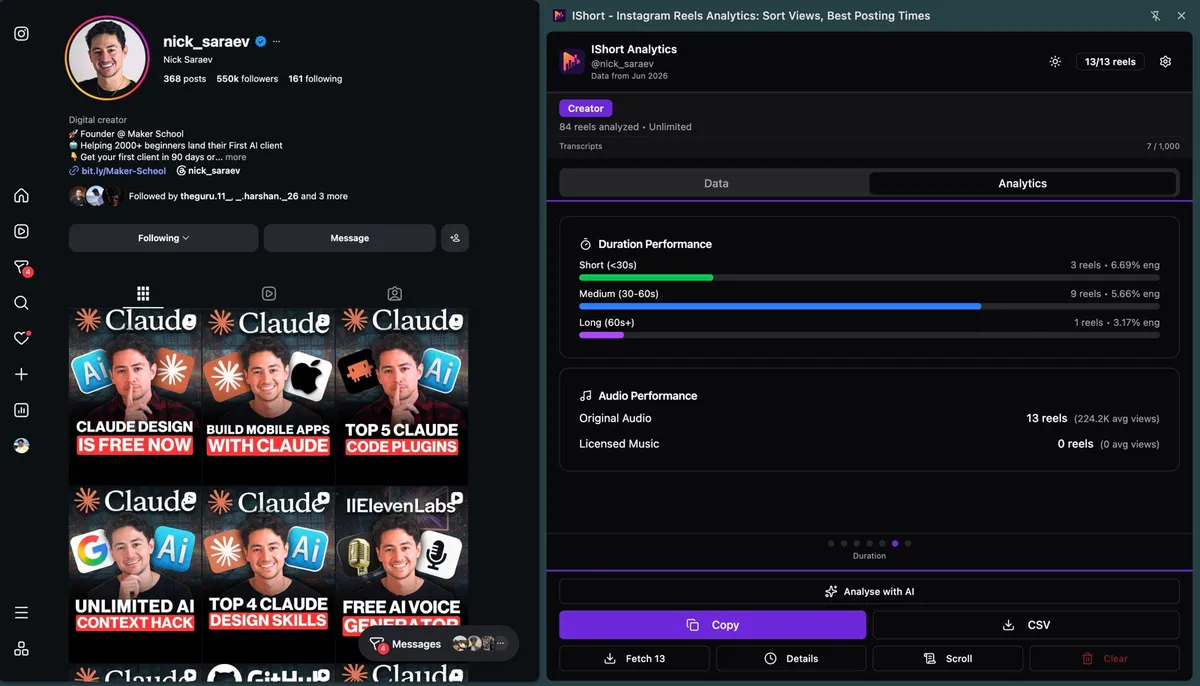
Instagram does not give you a multi-Reel comparison view. To compare watch time across your entire catalogue you have two options: export Insights month-by-month from the desktop Meta Business Suite, or use a tool like the IShort Chrome extension to capture public proxies (like-to-view ratio, save rate, completion-rate proxies) for every Reel on any profile. IShort's analytics dashboard tends to correlate with Insights watch time — not as good as ground-truth Insights, but it lets you scan hundreds of Reels in seconds and find your top-performing Reels instantly. For a deeper Insights walkthrough see how to view Instagram Insights.
Watch Time Benchmarks by Niche (2026)
Average watch time varies more by niche than by follower count. Below are the medians from our Q1 2026 cohort, segmented by industry. Use these as a sanity check, not a target — your own audience curve is what matters.
| Niche | Median completion rate (15-30s) | Median avg watch time | Top quartile avg watch time |
|---|---|---|---|
| Food & recipes | 46% | 17.2s | 24.1s |
| Personal finance | 52% | 19.8s | 27.6s |
| Fashion & beauty | 34% | 13.1s | 18.4s |
| Fitness & wellness | 41% | 15.7s | 22.0s |
| Tech & SaaS | 38% | 14.5s | 21.2s |
| Travel | 36% | 13.8s | 19.9s |
| Comedy & entertainment | 58% | 20.6s | 28.3s |
Food, finance, and comedy outperform because their formats have clearer payoffs — a finished plate, a number revealed, a punchline. Fashion and travel suffer because the content is often atmospheric rather than payoff-driven. If you are in a low-completion niche, the lever is structure: add a payoff that arrives before the median swipe-out point in your category. Cross-reference platform-wide medians against your own using our engagement rate calculator.
6 Common Watch Time Killers
If your watch time is below the medians above, the cause is almost always one of these six.
- Slow intro. Any pause longer than 0.5 seconds before the hook is a swipe trigger. Cut the first 0.3 seconds of every Reel before publishing — you will be surprised how much it helps.
- Weak audio. Trending audio brings broader, less qualified reach. Our sample showed a +3% lift in plays but a -4% drop in completion when using trending audio versus original audio. See original audio versus trending sounds.
- Poor pacing. Reels with cuts every 1.5-2 seconds outperformed Reels with longer single shots in nearly every niche. Movement keeps the eye engaged.
- No payoff. If your viewer cannot answer "what was that Reel about" five seconds after watching, you have not delivered a payoff. Tell them what they will get, then deliver it.
- Bad thumbnail. The cover image people see in profile grids and Explore is your second hook. Mismatched covers create swipe-aways even before playback starts.
- Wrong audience targeting. The algorithm tests every Reel on a small audience first. If that test audience is wrong, completion rate craters. Hashtags, captions, and posting time all shape the test cohort — see our best hashtags for Reels guide.
Field Notes
Three patterns from the IShort dataset stood out enough to flag separately.
- Captions raised completion rate by 12% on average, even with audio on. Instagram auto-mutes the feed for many viewers; captions retain them long enough for audio to start.
- Vertical text density matters. Reels with on-screen text occupying more than 30% of the vertical area saw a +9% lift in completion, likely because viewers feel obligated to read it.
- Loop-able endings (last frame matches first) averaged 1.34 plays per unique viewer versus 1.07 for Reels with hard endings — a 26% lift in watch time per impression with zero extra production cost.
Methodology & data limits
Spotted an error? Tell us — we publish a corrections log and revise within 7 days.
What We Still Do Not Know
Instagram does not publish the exact weight watch time carries in the ranking model. We know it is the dominant public signal — Mosseri has said so directly — but we do not know its relative weight against save rate, share rate, comment rate, or send rate. Mosseri has also said the system "constantly evolves," which is an honest way of saying the weights move. Our recommendations focus on watch time because every public Meta statement and every model update commentary across 2025-2026 has named it as the top signal. They do not focus on it because we have insider data.
Stop Guessing. Start Measuring.
Install IShort and track watch time proxies across every Reel you publish — sortable, exportable, and free forever.
Get IShort FreeFrequently Asked Questions
Is watch time really the #1 Instagram Reels ranking signal in 2026?
Yes — watch time is the #1 Instagram Reels ranking signal in 2026. Adam Mosseri confirmed on @creators that watch time and completion probability are the strongest signals. Meta's ranking explainer also names sends and likes per reach as core inputs.
What is a good average watch time for an Instagram Reel?
A good average watch time for an Instagram Reel is 14.8s on 15-30s Reels and 21.3s on 30-60s Reels (10,000-Reel IShort dataset). Top-quartile Reels exceed 60% completion; above 50% on a 30s+ Reel is strong. Niche matters. Below: niche benchmarks.
Why is the first 3 seconds so important for Reels watch time?
The first 3 seconds matter for Reels watch time because Instagram registers a view at the 3-second mark, and watch time accrues from millisecond one. Our data shows 0.81 correlation between 3-sec retention and completion. Swipe before 3s = no signal.
Do sub-90s Reels still beat 20-minute Reels after the November 2025 length change?
Yes, for feed discovery. Instagram raised the Reel length cap to 20 minutes in November 2025 to compete with YouTube long-form, but feed-distribution Reels still cap their algorithmic boost around 90 seconds. Long Reels gain traction on profile pages and Saved tabs, not the main Reels feed. Keep discovery Reels under 90 seconds in 2026.
How can I track watch time across all my Reels at once?
Instagram Insights only shows watch time one Reel at a time. To compare across your full catalogue, export Insights month-by-month, or use a tool like the IShort Chrome extension, which captures public engagement proxies (like-to-view ratio, save rate, completion-rate proxies) for every Reel on any profile and exports to CSV or Google Sheets.