

Quick answer: "Trending audio" does not only mean the chart song of the week. When we analyzed 150 of the top-performing Reels across niches, 78% used original audio and only about 21% used licensed music. The play: use a genuinely trending sound to catch a wave of reach, but build original audio when you want to own a sound other creators reuse. Below is how to find trending audio in 2026, when to choose original vs trending, and how to see exactly which sounds your competitors' best Reels used.
What "trending audio" actually means on Instagram
On Instagram, the audio on a Reel is either a licensed track from Instagram's built-in music library (a song you pick from the catalog) or original audio — the sound recorded or uploaded with the Reel itself. Original audio includes your voice, a voiceover, a custom mix, or any remixable clip you post. A sound becomes "trending" when a rising number of new Reels start using that same audio inside a short window, and Instagram flags it with a small upward arrow in the audio browser.
Here is the nuance most guides skip: a trending sound gives your Reel a chance to ride an existing wave of attention, because Instagram groups Reels that share an audio and viewers tap from one to the next. But trending audio is also crowded — thousands of creators pile onto the same sound the same week — so it is a boost, not a guarantee. And as the data below shows, the biggest Reels are not actually built on chart songs at all.
The data: original audio dominates top Reels
We took a corpus of 150 top-performing public Reels and tagged each one by audio type. The split was decisive:
| Audio type | Share of top Reels | What it tells you |
|---|---|---|
| Original audio | 78% (117 of 150) | Voice, voiceover, and custom mixes own the top of the distribution. |
| Licensed music | ~21% (31 of 150) | Trending songs still work — strongest on visual, wordless Reels. |
| Other / unlabeled | ~1% (2 of 150) | A small remainder we could not classify. |
Real examples from that set (public accounts, public view counts — non-English hooks translated):
- @swati_bhambra — ~82.2M views, original audio. A skincare Reel whose Hindi hook translates as "No foundation, no filter — just this tissue, and look at my skin glowing like glass." The single most-viewed Reel in our set rode original audio, not a licensed song.
- @thekumarmethod — ~34M views, original audio. A talk-to-camera finance Reel opening "This is a message to all finance pros," with a 7.8% engagement rate — evidence that a clear voice over original audio can out-travel a trending track.
- @drjyothishmalayalam — ~4.4M views, licensed music ("Paranje Paranje"). A Malayalam travel Reel (hook: "Watch what happens in this video — as a snake slips past, it strikes the edge of a blade") shows trending licensed music still performs, especially for visual, wordless storytelling.
Why this matters: "Trending" is not the same as "chart song." Original audio owns the top of the distribution, while trending licensed music is a strong secondary lever. Use trending audio to borrow reach; use original audio to own a sound that others can reuse — every reuse sends fresh viewers back to your Reel.
How to find trending audio on Instagram (2026)
- Open the Reels audio browser. Start a new Reel, tap the music / audio note icon, and scan for tracks marked with a small upward arrow — that arrow is Instagram's own signal that a sound is rising.
- Save sounds as you scroll. While watching Reels, tap the audio name at the bottom of the screen, then tap the bookmark / save icon. Build a running library of sounds you could use before they peak.
- Watch your niche, not the global chart. A sound trending in dance may do nothing for a finance page. Track the audio your niche's top creators are using right now — that is where a tool like IShort (below) does the digging for you.
- Move fast. Trending sounds have a short shelf life — often a few days to about two weeks. Jump on a rising sound early, not after it has already peaked and saturated.
- Check the usage count. Tap into a sound to see how many Reels use it. A track with a few thousand to low hundreds-of-thousands of uses is often a sweeter spot than one already sitting in the millions (too crowded to stand out).
Original vs trending audio: when to use each
Use trending audio when…
You want quick reach, your Reel is visual or wordless, you are joining a format or meme, or you are a newer account still building discovery. The song carries the mood.
Use original audio when…
You talk to camera, teach, or tell a story — and when you want to own a sound others remix. 78% of the top Reels we analyzed used original audio.
Or do both (hybrid)…
Record an original voiceover over a low, quiet bed of a trending track. You keep your original-audio ownership while still nodding to a current sound.
How long should your Reel audio be?
Match the audio to your content — do not stretch content just to fit a song. The median length of the top Reels we analyzed was about 49 seconds, and strong performers ranged from tight sub-20-second clips to 90-second-plus explainers. For most talking or tutorial Reels, 15 to 60 seconds is the practical sweet spot. When you use a trending song, sync its beat or drop to your strongest visual moment inside the first few seconds, so the hook and the sound land together.
See exactly what audio a competitor used
Guessing which sounds work in your niche is slow. With the free IShort Chrome extension you can open any public Instagram profile and instantly see its original-vs-trending audio split plus which sounds its top Reels actually used — the music name and audio type sit right alongside views, likes, and engagement for every Reel. Sort a competitor's library by views and you can read their audio strategy off the top row: are their biggest hits carried by original voiceovers, or by a specific trending track you could put your own spin on?
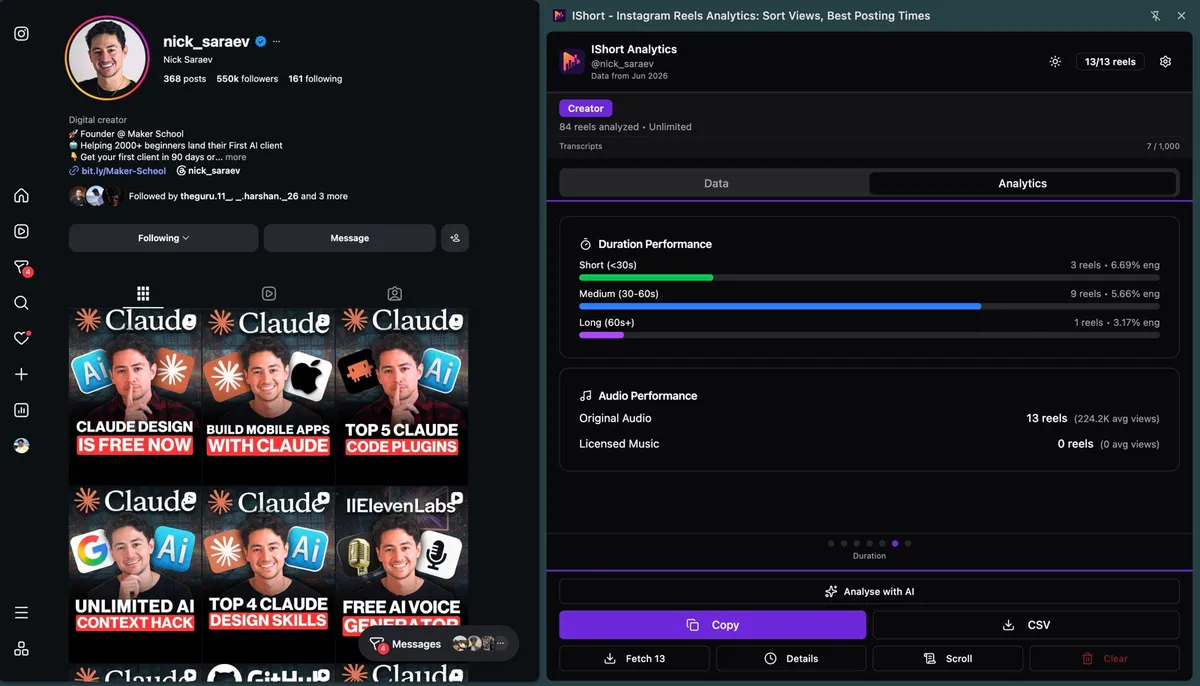
From there it is a copy-what-works loop: find the audio patterns that already drive views in your space, then apply them to your own posts. Pair this with our guide to getting more views on Instagram Reels, and use competitor Reels analysis to benchmark the accounts you are chasing.
Find the sounds that actually work in your niche
Install IShort free and see the original-vs-trending audio split — plus the exact sounds behind the top Reels — for any public profile. No login, no cost.
Add to Chrome — Free Add to Edge — FreeFrequently Asked Questions
What is trending audio on Instagram Reels?
Trending audio is a sound — either a licensed song from Instagram's music library or an original audio clip — that a rising number of new Reels are using in a short window. Instagram marks these with a small upward arrow in the audio browser. Using a trending sound can help your Reel ride an existing wave of attention, because Instagram groups together Reels that share the same audio so viewers tap from one to the next.
How do I find trending sounds on Instagram?
Open a new Reel and tap the audio or music icon, then look for tracks with an upward arrow, which marks rising sounds. Save sounds as you scroll your feed by tapping the audio name and bookmarking it, and pay attention to what the top creators in your specific niche are using rather than the global chart. Move quickly, because most trending sounds peak within a few days to about two weeks.
Do original or trending sounds perform better?
In our analysis of 150 top-performing Reels, 78% used original audio and only about 21% used licensed music, so original audio clearly dominates the top of the distribution. Use trending licensed music to catch a wave of reach — especially on visual, wordless Reels — but use original audio (your voice, a voiceover, or a custom mix) when you want to own a sound that others can reuse and that sends new viewers back to you.
How many seconds should Reel audio be?
Match the audio to your content rather than stretching content to fit a song. The median length of the top Reels we analyzed was about 49 seconds. For most talking or tutorial Reels, 15 to 60 seconds works well; when you use a trending song, sync its beat or drop to your strongest visual moment within the first few seconds.
Can I see what audio a competitor used?
Yes. With the free IShort Chrome extension you can open any public Instagram profile and see its original-vs-trending audio split along with the exact sounds its top Reels used, so you can copy the audio strategy that already works in your niche instead of guessing.
Final thoughts
The word "trending" tricks a lot of creators into chasing chart songs, but the data tells a calmer story: the biggest Reels are overwhelmingly built on original audio. Treat trending licensed music as a reach accelerant for the right, visual Reels — and invest in original voiceovers and mixes as the asset that compounds, because every creator who reuses your sound funnels new viewers back to you. Find the audio that already works in your niche, match it to a tight hook in the first few seconds, and let the data — not the hype — pick your sounds.