

Quick answer: On April 30, 2026, Instagram head Adam Mosseri announced that accounts which primarily share content they did not create will no longer be recommended to people who don't already follow them. Reposts and near-duplicates get deprioritized in favor of the original creator. But a Reel that uses someone else's clips can still count as original if you add genuinely new value. To stay recommendable in 2026: post original content, remove other-app watermarks, and add real value when you build on others' clips.
What Instagram's original-content rule actually says
On April 30, 2026, Instagram head Adam Mosseri announced a change to how recommendations work: accounts that primarily share content they did not create will no longer be recommended to people who don't already follow them. His words were blunt:
“If most of what you post to Instagram is someone else's content, your account is no longer going to be recommendable.” — Adam Mosseri, Instagram
This is a meaningful shift. Recommendations — the Reels tab, Explore, and suggested posts — are how most accounts reach people beyond their existing followers. If your account is no longer recommendable, your content effectively stops reaching new audiences and only surfaces to people who already follow you. For accounts built on reposting, that is a hard ceiling on growth.
Notice the word "primarily." The rule is aimed at the account level, not a single post. Instagram's concern is accounts whose feed is mostly other people's videos — the classic aggregator, meme-dump, and quote-repost pages that grew by re-sharing viral clips at volume. A creator who occasionally features a clip inside their own original work is in a very different position from an account whose entire identity is republishing what others made. The change is less about policing one Reel and more about deciding which accounts deserve to be pushed to strangers.
What counts as "unoriginal" content
Instagram deprioritizes unoriginal content in favor of the original creator's version. According to Instagram, unoriginal content includes:
- Reposts — re-sharing another account's video as your own.
- Near-duplicates — videos that are only trivially different from an existing post.
- Reused visuals or audio — videos that reuse large portions of another creator's footage or sound without adding to it.
- Watermarked content — videos that carry another app's watermark, for example a TikTok watermark, are a clear signal the content originated elsewhere.
When Instagram detects this kind of content, it deprioritizes the copy and points people toward the original creator instead. And there is a harsher consequence at the account level: aggregator-style accounts that mostly repost can lose access to recommendations entirely. That is the scenario Mosseri described — if most of what you post is someone else's, the whole account stops being recommendable.
The logic is straightforward once you see it from Instagram's side. If a video is going to be shown to millions of strangers, Instagram would rather send that reach — and the follows, credit, and audience that come with it — to the person who actually made it, not to whoever re-uploaded it fastest. Deprioritizing duplicates protects original creators from being out-distributed by copies of their own work, and it removes the incentive to build an account purely by harvesting other people's Reels.
What still counts as "original" (the value-add nuance)
Here is the nuance that matters most, and the part creators most often get wrong: using someone else's clip does not automatically make your Reel unoriginal.
A Reel that uses third-party footage can still count as original if your on-screen presence or voice is the focus and you add genuinely new value. Instagram frames that value as:
- Fresh information — you tell people something the original clip did not.
- Fresh analysis — you break down, explain, or critique what's happening.
- A meaningful contribution to the storyline — you build on the clip so the result is genuinely yours.
In other words, reaction and commentary done well is fine. A creator reacting on camera, adding expert analysis, or weaving a clip into their own narrative is creating something new. What gets penalized is lazy reposting — grabbing a video, changing nothing meaningful, and passing it off as your own. The difference is whether you actually added to the content or simply re-shared it.
It helps to picture a spectrum. At one end sits a bare repost: someone else's Reel, re-uploaded untouched, sometimes still wearing a TikTok watermark — clearly unoriginal. At the other end sits a Reel where you appear on camera, use a short third-party clip to illustrate a point, and spend most of the runtime adding your own explanation, opinion, or story — clearly original. Most borderline cases come down to one honest question: if you stripped out everyone else's footage, would there still be something of yours left? If the answer is yes, you're adding value. If the answer is no, you're reposting.
Best practices to stay recommendable in 2026
To keep your account recommendable under the 2026 rule, the practical takeaway is straightforward:
- Post original content. Make sure the majority of what you publish is genuinely yours — your footage, your voice, your ideas. This is now the baseline for being recommended at all.
- Remove other-app watermarks. If you repurpose your own footage from TikTok or another platform, strip the watermark and re-export natively for Instagram. A visible watermark is one of the clearest unoriginal-content flags.
- Add real value when you build on others' clips. If you use third-party footage, put yourself in it — on camera or in voiceover — and contribute fresh information, analysis, or storytelling. React and comment; don't just re-share.
- Lead with your own perspective. The safest content is content only you could make: your take, your face, your expertise. That's also what tends to build a loyal audience.
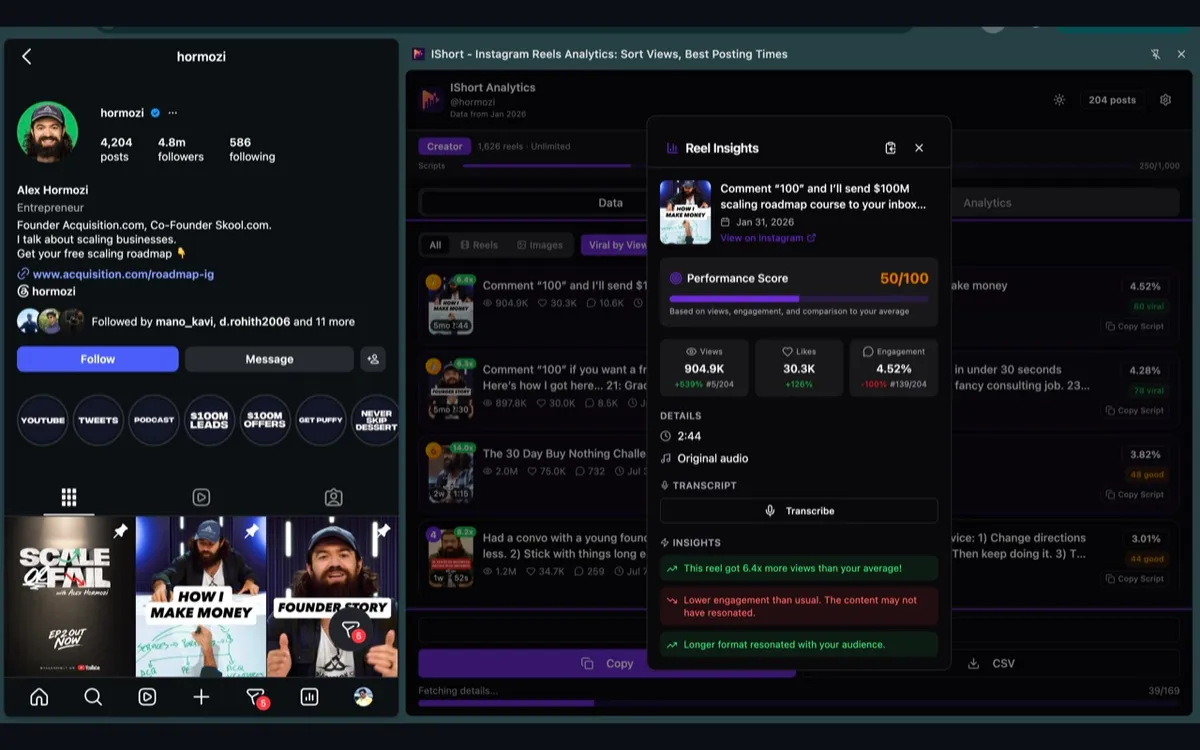
How to find the original formats that win in your niche
The rule rewards original content — but "original" doesn't mean "guess and hope." The smartest creators study what original formats are already working in their niche, then create their own take on those proven patterns. That's very different from reposting: you're learning the format, not copying the video.
The free IShort Chrome extension is built for exactly this. Open the Reels tab of the top original creators in your niche and IShort captures each Reel's views, likes, comments, hashtags, and audio — so you can:
- Sort their Reels by views to find the true breakout originals, not their average posts.
- Study the hooks and formats on those winners — the opening seconds, the structure, the pacing that earned the reach.
- See the hashtags and audio that classify those Reels, so your original content lands in the right place.
IShort is an analytics tool, not an auto-poster — there's no login or business account required, and it doesn't create or repost anything for you. It simply shows you what original content performs so you can build your own. For the full workflow, see our guide to analyzing competitor Instagram Reels, and pair it with the fundamentals in how to get more views on Instagram Reels.
Create original content that performs — don't repost. Install the free IShort Chrome extension, open the top original creators in your niche, sort by views, and study the hooks, formats, and hashtags on their best Reels. Then make your own version — original, recommendable, and built on what actually works.