

Quick answer: A Reel that tells a story keeps people watching, and watch time is what earns reach. The most reliable structure is a five-beat arc: hook in the first two seconds, then tension (the problem), a payoff (the answer or turn), proof (why to believe it), and a call to action. Give every Reel a clear beginning, middle, and end - and reverse-engineer the beats top creators already use. Here is how.
Why storytelling beats "good content"
Plenty of well-shot Reels flop because they are clips, not stories. A clip shows something; a story makes you need to know what happens next. That tension - the open loop between a question and its answer - is what holds attention past the first swipe, and attention is the currency Instagram rewards. Instagram's own creator guidance (creators.instagram.com) keeps returning to watch time and completion, and story structure is the most dependable way to earn both.
Agencies that study this for a living - The Influence Agency among them - make the same case: audiences remember and share narratives, not features. A story gives your information a reason to be watched to the end.
The 5-beat Reel story framework
Almost every Reel that holds attention moves through the same five beats. You can run this arc in 15 seconds or 60 - the structure matters more than the length.
- Hook (first 2 seconds). Open a loop. State the stakes, the result, or the question the whole Reel will answer. If the hook is weak, no one sees the rest.
- Tension (the problem). Name the struggle, the mistake, or the "before." This is what makes the viewer lean in - they recognize themselves in it.
- Payoff (the turn). Deliver the answer, the transformation, or the reveal. This is the moment the open loop closes.
- Proof (why believe it). Back the payoff with a result, a demo, a number, or a before-and-after so it does not feel like a claim.
- Call to action. Tell the viewer the one next step - follow for more, save this, or try it - while their attention is still on you.
Every Reel needs a beginning, middle, and end
The five beats collapse into the oldest structure there is. The beginning (hook and tension) earns attention and sets the stakes. The middle (payoff and proof) delivers on the promise the hook made. The end (call to action, and ideally a loop back to the opening) tells people what to do and often rewards a rewatch. When a Reel feels flat, it is almost always missing one of these - usually a real ending, or a middle that pays off the hook.
Story angles that travel
The framework is the skeleton; the angle is what makes a viewer feel something. These are the angles that reliably get shared because they are about people, not information.
Relatable POV
"When you..." moments that name a shared experience. The viewer shares it because it says something they could not.
Transformation
Before-and-after, zero-to-one, or a mistake-to-fix arc. Change is the most watchable story shape there is.
Behind the scenes
The messy middle no one shows - the process, the fail, the real work behind the result.
Contrarian take
"Everyone says X, but..." An honest counterpoint creates instant tension and pulls comments.
Write the hook for the first 2 seconds
The hook is the story beat that decides whether the other four get seen, so write it last and hardest. A strong hook makes a promise the rest of the Reel keeps: it hints at the payoff without giving it away. Lead with tension or the result - never a slow intro, a greeting, or a logo. Match the on-screen text to the spoken line so the message lands whether the sound is on or off.
If hooks are your weak point, our guide to Instagram Reel hooks has patterns you can adapt, and writing a Reel script shows how to structure the whole thing around one.
Reverse-engineer the stories that already work
The fastest way to learn story structure is to take apart Reels that already nailed it. Reading a winning Reel's transcript exposes its skeleton - where the hook lands, how fast the tension arrives, when the payoff drops. The free IShort Chrome extension can transcribe any public Reel in 11 languages, so you can pull the exact words a top creator used and map them to the five-beat arc. Its 0 to 100 Viral Score tells you which of a creator's stories actually broke out, so you study the structures that landed, not the ones that flopped.
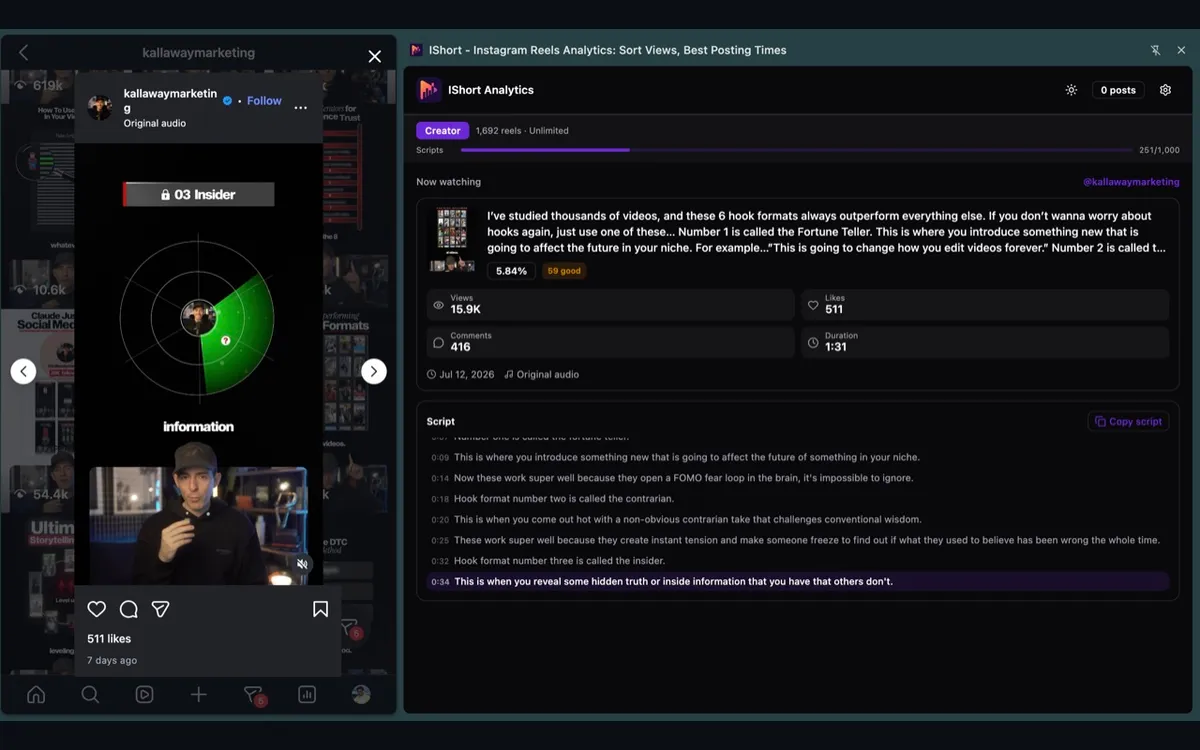
Do this across a few high-Viral-Score Reels in your niche and the patterns jump out: how long their hooks are, where the turn happens, how they close. Then write your own scripts to the same beats. Start by transcribing the Reels you admire and studying the structure behind them.
Reverse-engineer the Reels that hook
Install IShort free, transcribe any public Reel in 11 languages, and use the Viral Score to study the story structures that actually landed. No login, no cost.
Add to Chrome - Free Add to Edge - FreeFrequently Asked Questions
What is the best story structure for Instagram Reels?
The most reliable structure is a five-beat arc: a hook in the first two seconds, tension that names the problem, a payoff that delivers the answer or turn, proof that backs it up, and a call to action. It maps onto the classic beginning, middle, and end, and it works whether your Reel is 15 seconds or a minute long.
How do I hook viewers in the first two seconds?
Open a loop - state the result, the stakes, or the question your Reel will answer - so the viewer needs to keep watching to resolve it. Lead with tension or the payoff rather than a greeting, intro, or logo, and match your on-screen text to your spoken line so the hook lands with the sound on or off.
How long should a storytelling Reel be?
Long enough to complete the arc and no longer. Many strong story Reels run 15 to 45 seconds - enough to hook, build tension, pay it off, and close. Let the story decide the length rather than padding to hit a number; a tight 20-second story beats a slow 60-second one every time.
Do I need to show my face to tell a story on Reels?
No. Voiceovers, screen recordings, text-on-screen, and b-roll can all carry a story. The beats matter more than the format - a faceless Reel with a sharp hook, real tension, and a satisfying payoff will out-perform a talking-head clip with no structure. What you need is a clear point of view, not a face.
How do I learn what story structures work in my niche?
Reverse-engineer the Reels that already won. Transcribe top-performing Reels in your niche to see the exact words and beats the creator used, and use a performance score to confirm which ones actually broke out. Map those transcripts to the five-beat arc, then write your own scripts to the same structure.
Final thoughts
Information tells; stories make people stay. Once you see Reels as a five-beat arc - hook, tension, payoff, proof, call to action - you stop making clips and start making things people watch to the end and send to a friend. You do not have to guess at the shape: the winning Reels in your niche are worked examples you can transcribe, map, and learn from. Nail the first two seconds, honor the beginning-middle-end, and let the structure do the heavy lifting.