

Quick Answer: A high-retention Instagram Reel script has four beats: a hook that earns the first 3 seconds, a value section that delivers on the hook's promise, a payoff that rewards the viewer, and a CTA. Write the hook first, keep the whole thing to 30-60 spoken words for a 20-40 second Reel, write for the ear (not the page), and cut every word that does not push the story forward.
Skip the Blank Page: Extract 10 Proven Scripts First
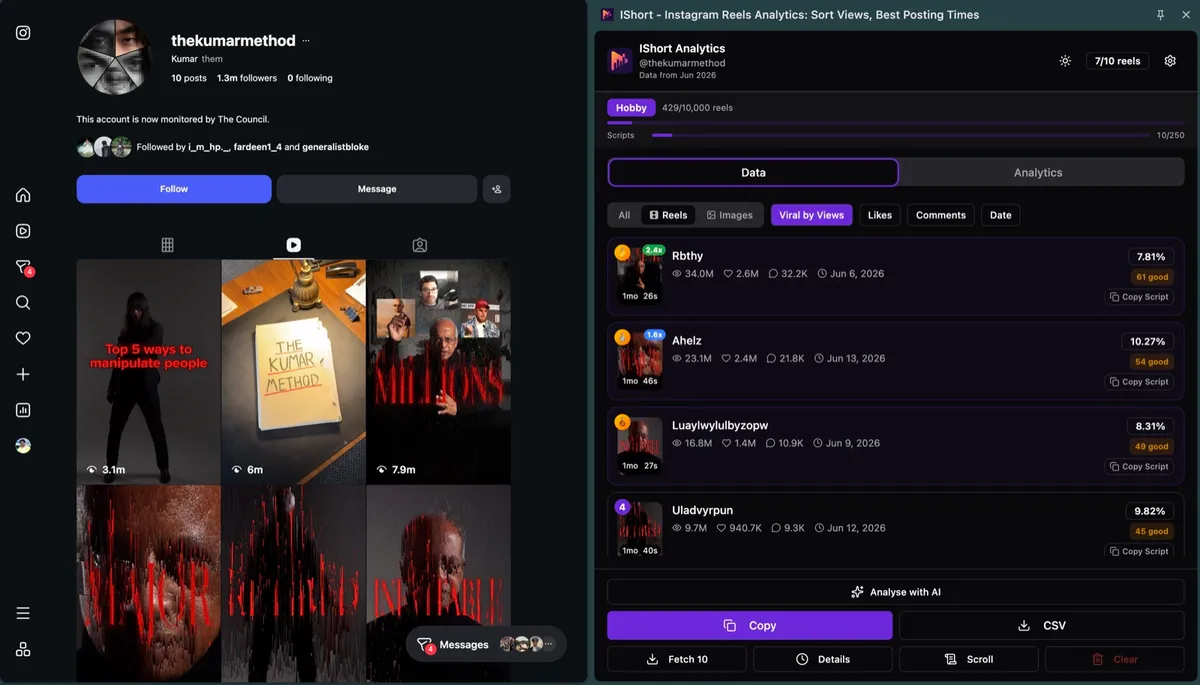
The fastest way to write a great Reel script is to study the ones that already worked in your niche — then remix, not copy. Here is the exact workflow with IShort:
- Find a top account in your niche. Open a competitor or a creator whose Reels consistently go viral.
- Sort their Reels by views. IShort collects the whole library and lets you analyze any public account — no Instagram login required — so their best performers rise to the top instantly.
- Transcribe the top 10. One click pulls the full spoken script of each Reel. IShort's transcription is server-side and auto-detects 11 languages (English plus Hindi, Bengali, Tamil, Telugu, Gujarati, Kannada, Malayalam, Marathi, Odia, and Punjabi), so it works for regional creators too.
- Reverse-engineer the pattern. Line up all 10 hooks side by side. You will see the formulas from this guide repeating. Note the pacing, the payoff placement, and the CTA.
- Remix into your own script. Rewrite the winning structure in your voice, with your example and your payoff. Structure is not copying — the words and value are yours.
This turns "what do I even say?" into a fill-in-the-blank exercise backed by data. If you want a starting scaffold instead, our Reel script generator and templates pairs perfectly with this workflow.
Never Start From a Blank Page Again
Use IShort to sort any public account's Reels by views, then one-click transcribe the top 10 performers in your niche. Study the exact hooks and structures that already work — then remix them into your own high-retention scripts.
Install IShort FreeWhy Your Reel Script Matters More Than Your Camera
Most creators obsess over lighting, transitions, and trending audio, then wing the words. That is backwards. The script is what decides whether a viewer stays past the first three seconds, and watch time is the single biggest signal the Instagram algorithm uses to decide how far your Reel travels. A great script filmed on a phone will out-perform a beautifully shot Reel with a rambling, unfocused voiceover every single time.
Scriptwriting for Instagram is not the same as writing a blog post or a YouTube video. You have seconds, not minutes. Every line has to justify the next line. In this guide you will learn the exact anatomy of a Reel script, seven proven hook formulas with examples, how to pace and time your words for maximum watch time, the mistakes that quietly kill retention, and a full worked example you can copy today.
The Anatomy of a High-Retention Reel Script
Every Reel that holds attention follows the same four-part skeleton. Learn it once and you can script any topic in any niche.
1. Hook (0-3s)
One line that opens a curiosity loop or promises a payoff. Its only job is to stop the scroll and buy the next three seconds.
2. Value / Build (3-25s)
Deliver on the hook's promise in tight, sequential steps. Each sentence sets up a small question the next one answers.
3. Payoff (final beat)
The reward — the result, the reveal, the "aha." This is what viewers came for and what makes them share or save.
4. CTA
One clear next action: follow, comment a keyword, save, or watch a linked Reel. Never stack more than one.
The mistake most creators make is front-loading the boring part. They introduce themselves, explain context, and set up the topic before getting to the point. By then, half the audience is gone. The four-beat structure forces the payoff-promise into the first line and pays it off before the viewer loses patience.
7 Proven Hook Formulas (With Examples)
The hook is 80% of the job. If you only script one thing word-for-word, script this. Here are seven formulas that reliably stop the scroll, each with a fill-in-the-blank template and a real example.
| Formula | Template | Example |
|---|---|---|
| 1. Curiosity Gap | "The one thing nobody tells you about ___" | "The one thing nobody tells you about growing on Reels in 2026." |
| 2. Bold Claim | "___ is a waste of time. Do this instead." | "Posting 3 times a day is a waste of time. Do this instead." |
| 3. Direct Value | "3 ways to ___ (that actually work)" | "3 ways to write a Reel hook that actually work." |
| 4. Relatable Pain | "POV: you just ___ and ___" | "POV: you posted your best Reel and it got 200 views." |
| 5. Contrarian | "Everyone says ___. They're wrong." | "Everyone says hashtags are dead. They're wrong — here's proof." |
| 6. Result / Proof | "I did ___ for ___ days. Here's what happened." | "I analyzed 100 viral Reels in my niche. Here's what they all did." |
| 7. Question Hook | "Why do your Reels ___ when ___?" | "Why do your Reels flop when your photos do fine?" |
Notice that every one of these opens a loop the viewer needs to close. That tension — the gap between what they know and what you just implied — is what keeps a thumb from swiping. Pair a spoken hook with an on-screen text version of the same line so it lands for the 85% of viewers who watch on mute. For more on turning a strong hook into a full-blown viral Reel, see our go viral on Instagram Reels playbook.
Pacing, Length, and Word Count
A script that reads well silently can still drag on camera. Reels reward density. Here is how to calibrate length.
- Words per second: Aim for 2 to 2.5 spoken words per second at a natural, energetic pace.
- 20-second Reel: roughly 45-55 words.
- 30-second Reel: roughly 70-80 words.
- 40-second Reel: roughly 90-110 words.
Shorter almost always wins. When you are forced to say the same thing in fewer words, you cut the filler and the payoff arrives sooner. There is no single perfect duration, but for most educational and entertainment content the sweet spot lands between 15 and 40 seconds — dig into the data behind that in our best Reel length for engagement breakdown.
One more pacing rule: change something visually every 2-3 seconds. A new angle, a text pop, a cut, a B-roll insert. Your script should be written with these beats in mind so the words and the visuals turn over together and the Reel never feels static.
Scripting for Watch Time (Not Just Words)
Retention is engineered line by line. A few techniques that reliably lift watch time:
Open Loops
Tease the payoff early ("the third one surprised me") so viewers stay to reach it.
No Dead Air
Cut breaths, pauses, and "um"s in the edit. Every silent frame is an exit ramp.
Bridge Lines
End each point with a hook into the next: "but that only works if…"
Loop the Ending
Write the last line so it flows back into the first, encouraging re-watches.
Watch time is the metric that compounds. IShort lets you sort your Reels by views and compare the highest performers, so you can reverse-engineer which script structures actually drove retention on your own account and write more of them.
Common Reel Scripting Mistakes
- Burying the hook. If your best line is at second 8, move it to second 0.
- Writing for the eye, not the ear. Read every script aloud. If it sounds like a term paper, rewrite it in the way you actually talk.
- Too many ideas. One Reel, one idea, one payoff. Save the rest for the next Reel.
- Weak or stacked CTAs. "Like, comment, share, follow, and save" converts nobody. Ask for one thing.
- No on-screen text. Most viewers watch muted; if your script only lives in the audio, it does not exist for them.
- Starting from a blank page. The hardest and most avoidable mistake. You do not have to invent structure from scratch when proven scripts already exist in your niche.
A Worked Example: Full Reel Script
Here is a complete 30-second script for a fictional Reel in the creator-growth niche, annotated by beat. Total word count: about 78 words, which fits comfortably in 30 seconds at a natural pace.
| Beat | Script line | On-screen / visual |
|---|---|---|
| Hook (0-3s) | "Your Reels aren't flopping because of the algorithm. It's your first line." | Bold text: "It's your first line." Close-up, direct to camera. |
| Build (3-12s) | "Most people open with 'hey guys, so today I wanted to talk about…' — and that's exactly where you lose them." | Cut to a phone showing a view counter stuck low. |
| Build (12-22s) | "Instead, open a loop. Make a bold claim, ask a question, or promise a result in the first three seconds. Then pay it off fast." | Three quick text cards flashing: Claim / Question / Result. |
| Payoff (22-27s) | "I rewrote one hook on an old Reel and it went from 400 views to 40,000." | Screen recording of the two view counts side by side. |
| CTA (27-30s) | "Comment 'HOOK' and I'll send you my 7 hook formulas." | Text: "Comment HOOK 👇" Loop back to the opening frame. |
Notice how the last line loops back to the first, how each build line bridges into the next, and how the payoff is a concrete, specific result rather than a vague promise. Swap in your niche, your example, and your CTA, and you have a repeatable template.
Turn One Script Into a System
Once one script works, do not treat it as a one-off. Save the structure. The creators who grow fastest run a small library of proven script skeletons and refill them with new topics every week. Combine that with the right hashtag strategy and consistent posting, and your hit rate climbs instead of relying on luck.
The loop is simple: write with the four-beat structure, publish, then sort your Reels by views in IShort to see which scripts retained best, and double down on those formulas. Data closes the gap between guessing and knowing.
Remember: the hook earns the view, the structure keeps it, and the payoff earns the share. Script those three deliberately — everything else is polish.
Frequently Asked Questions
How do you write a script for Instagram Reels?
Write an Instagram Reel script in four beats: a hook that earns the first 3 seconds, a value section that delivers on the hook's promise, a payoff that rewards the viewer, and a CTA. Draft the hook first, keep the whole script to 30-60 spoken words for a 20-40 second Reel, and write for the ear, not the page.
How long should an Instagram Reel script be?
Aim for roughly 2 to 2.5 spoken words per second, so a 20-second Reel needs about 45-55 words and a 40-second Reel about 90-110 words. Shorter scripts almost always retain better because they force you to cut filler and get to the payoff faster.
What is a good hook for an Instagram Reel?
A good hook creates an open loop in the first 3 seconds using curiosity, a bold claim, a relatable pain, or a direct promise of value. Examples: "Stop posting Reels until you fix this one thing" or "I analyzed 100 viral Reels in my niche and they all did this." The hook should make scrolling past feel like missing out.
Should I write a full script or just bullet points for Reels?
Fully script the hook and CTA word-for-word because those two beats decide watch time and conversions. The middle value section can be bullet points if you are comfortable on camera, which keeps delivery natural. If you tend to ramble, script the whole thing and read from a teleprompter app.
How do I find proven Reel scripts in my niche?
Instead of starting from a blank page, use IShort to sort a competitor's Reels by views, then one-click transcribe the top 10 performers. IShort's transcription auto-detects 11 languages, so you can study the exact hooks and script structure that already work in your niche and remix them into your own.
Final Thoughts
Writing a great Instagram Reel script is a skill, not a talent — and like any skill, it gets faster with a repeatable process. Master the four-beat structure, keep a bank of hook formulas, write tight for watch time, and never start from a blank page when proven scripts already exist in your niche. Pull the ones that worked, study why, and remix them in your own voice.
Install IShort to extract 10 proven scripts in your niche in minutes, and turn "what do I say?" into a data-backed system.