

Reels dominate discovery on Instagram in 2026, but the static photo post is far from dead. It just plays a different game. A Reel can be pushed to millions of non-followers by the recommendation engine, while a photo post earns its reach mostly from your existing audience and from the deep engagement signals it triggers: saves, shares, and sends. Understand those signals and you can still get real reach from single photos and carousels of stills. This guide breaks down how photo-post reach actually works in 2026 and how to grow it.
We will cover what reach really means for a static post, why saves and shares matter more than likes, how photos compare to Reels, and how to study the posts already winning in your niche with IShort's competitor analysis.
What "Reach" Means for a Photo Post
Reach is the number of unique accounts that saw your post. It is different from impressions (total views, including repeats) and from your follower count. For a photo post, reach comes from roughly three buckets:
- Follower reach - people who already follow you and see the post in their home feed. This is the largest slice for most photo posts.
- Hashtag and Explore reach - a smaller slice for static posts than for Reels, but real when a photo earns strong early engagement.
- Shared reach - accounts that see your post because someone sent it in a DM, added it to their Story, or it surfaced through saves-driven ranking.
The key thing to understand: Instagram decides how far to push a post partly by watching how your first viewers respond. If your existing followers save and share a photo quickly, Instagram reads that as a quality signal and shows it to more people. If they scroll past, the post stays small. For a fuller definition of the metric, see what "accounts reached" means on Instagram.
Photo Posts vs Reels Reach in 2026
It is no secret that Instagram pushes Reels harder than any other format. Video is where the recommendation engine lives, so Reels reach the highest share of non-followers. Photo posts lean on a different engine: your audience and the saves, shares, and sends they generate. Here is how the two compare:
| Metric | Photo Post | Reels |
|---|---|---|
| Non-follower reach | Lower | Highest |
| Discovery via recommendations | Limited | Strong |
| Save-rate potential | High | Medium |
| Share / send potential | High | Medium |
| Speed to create | Fast | Slower |
| Best for | Value, saves, brand recall | Discovery, new followers |
The takeaway is not "abandon photos." It is to use each format for what it does best. Reels bring new people in; photo posts and carousels convert that attention into saves, shares, and loyalty. If your Reels are underperforming, our guide on why your Reels get no views covers the common causes.
Saves & Shares Are the Real Ranking Signals
For static photo posts, likes are the weakest signal and saves and shares are the strongest. A like takes a fraction of a second and means little. A save means "I want to come back to this." A share or send means "this is worth someone else's time." Instagram treats those deep-intent actions as the clearest proof that a post deserves wider distribution.
So the entire game for photo-post reach is engineering saves and shares on purpose. That comes down to content that is either worth keeping or worth passing on:
Save-worthy value posts
Infographics, checklists, and tip breakdowns people bookmark to use later. If someone would screenshot it, they will save it instead.
Share-worthy relatable posts
Memes, hot takes, and "this is so me" moments people send to a friend or reshare to their Story. Relatability travels through DMs.
Reference material
Cheat sheets, frameworks, and step lists that answer a recurring question in your niche. Reference content earns saves for months.
Strong first-line captions
The caption hook decides whether people stop, read, and engage. Front-load the value or the tension in the first line.
How to Earn More Saves and Shares
- Lead with a clear promise. The image and first caption line should tell people exactly what they get by stopping.
- Make it genuinely useful or genuinely relatable. Aim to be save-worthy or share-worthy, ideally one of them strongly rather than both weakly.
- Add an explicit prompt. "Save this for later" and "send this to a friend who needs it" measurably lift those exact actions.
- Design for the feed. Readable text, high contrast, and a portrait 4:5 crop take up more screen and hold attention longer.
- Post when your audience is active so early engagement lands fast. See our best time to post guide for timing.
Single Photo vs Carousel for Reach
A single photo is the fastest way to post a save-worthy or share-worthy moment. But if reach is the goal, a carousel usually beats a single image. Every swipe adds time-on-post, and Instagram re-serves carousels to people who did not swipe to the end, giving the post multiple chances to land. Carousels also tend to earn more saves because they pack more reference value into one post.
The practical rule: use single photos for fast, high-impact moments and announcements; use carousels when you have a multi-step idea, a list, or a story worth swiping through. For the full carousel playbook - formats, slide structure, and split-screen contrasts - read our dedicated Instagram carousel strategy guide.
Study What Already Gets Reach in Your Niche
Guessing is slow. IShort lets you analyze any public creator's posts and Reels, sort them by engagement, and see which formats and topics earn the most interaction - then model what works for your own photo posts.
Install IShort FreeStudy Top-Performing Posts (and Download Them to Learn)
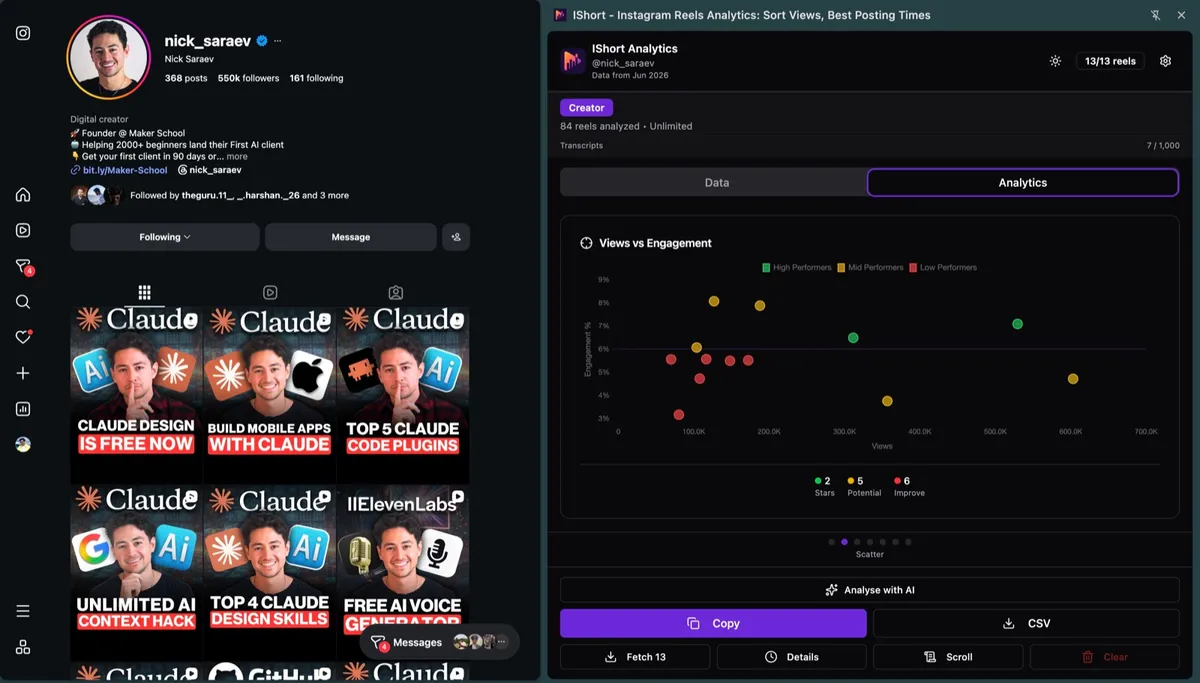
The fastest way to grow photo-post reach is to reverse-engineer posts that already have it. The IShort Chrome extension helps you do exactly that on any public account:
- Analyze a competitor's best content - Load a public profile and sort their posts and Reels by likes, comments, and engagement to see which formats and hooks drive the most interaction. IShort works with public engagement metrics, so you are studying what anyone can see, systematically.
- Spot the patterns - Look for the topics, captions, and post types that consistently outperform in your niche, then apply the same patterns to your own photo posts and carousels.
- Download to study and repurpose (new) - With IShort's downloader you can download any Instagram Reel (video), photo post (image), or carousel (multi-image) to study the framing, layout, and hook up close, or to repurpose a winning format into your own original post.
A quick note on honesty: IShort analyzes public engagement metrics and downloads public Reels, photo posts, and carousels. It does not pull Instagram's native reach or impressions numbers from Instagram's API, and it does not download Stories or private content. Use it to study what is working in the open and to build better posts of your own.
Frequently Asked Questions
Do photo posts still get reach in 2026?
Yes, but the mechanics are different from Reels. Instagram pushes Reels harder for discovery among non-followers, so a single photo post rarely reaches a large cold audience on its own. Photo posts earn reach primarily from your existing audience and from saves, shares, and sends. A photo that is highly saved or sent to friends can still travel well beyond your followers, it just relies on engagement signals rather than the video recommendation engine.
Do saves help photo posts rank?
Saves are one of the strongest signals for photo posts. A save tells Instagram the content was valuable enough to keep, and shares and sends tell Instagram it was worth passing to someone else. For static photo posts, these deep-intent signals carry more weight than likes. To earn them, make posts that are reference-worthy, such as infographics, tips, and checklists, or highly relatable so people send them to a friend.
Photo post or carousel for more reach?
Carousels generally out-reach single photo posts because each swipe adds time-on-post and gives Instagram more chances to re-surface the post to people who did not finish it. Single photos are still useful for fast, high-impact, save-worthy or share-worthy moments. If your goal is maximum reach and saves from static content, a carousel usually wins. See our Instagram carousel strategy guide for the full carousel playbook.
How do I see which of my photo posts got the most reach?
Instagram's own reach and impressions numbers live in Insights on a professional (Creator or Business) account. IShort does not pull those private Insights numbers. What IShort does is analyze public engagement on any public profile, so you can sort a creator's posts and Reels by likes, comments, and engagement to see which formats and topics perform best, and download Reels, photo posts, and carousels to study the winning formats up close.
Key Takeaway: Photo posts still earn reach in 2026, but through saves, shares, and sends rather than the Reels recommendation engine. Make posts worth keeping or worth passing on, prompt the action, and study the posts already winning in your niche with IShort. For maximum static reach, reach for a carousel.